The History of Lyric Videos: From Dylan's Cue Cards to Your Phone
The lyric video started as a stunt. In a 1965 film clip, Bob Dylan held up cards with words from his song and dropped them one by one. It took about 45 more years for labels to turn that idea into a regular release step.
Want the reasons people watch them instead of the dates? Read why lyric videos are popular. This post owns the timeline.
Lyric videos, 1965 to now
1965: Dylan's cue cards
"Subterranean Homesick Blues" comes out March 8, 1965. Its cue-card clip opens the film Dont Look Back. Source1987: Prince puts type on screen
"Sign o' the Times" comes out February 18, 1987. Its text video is often cited as one of the earliest lyric videos. INXS copies Dylan's cards in "Mediate" the same year. SourceAugust 2010: CeeLo Green goes lyric first
A kinetic type video (moving, animated words) for "F*** You" goes up on YouTube on August 19, 2010. The official video follows on September 1. SourceDecember 2013: "a mandatory step"
The Hollywood Reporter says lyric videos went from an occasional stunt to a mandatory step in a song's rollout. SourceAugust 2014: an award of its own
The MTV Video Music Awards give out Best Lyric Video. 5 Seconds of Summer win for "Don't Stop". Source2020s: vertical and automated
Tall 9:16 cuts for Shorts, Reels and TikTok. YouTube Shorts can run up to 3 minutes. Tools now time lyrics from the audio. Source
What was the first lyric video?
The clip most people point to is Bob Dylan's "Subterranean Homesick Blues." The song came out as a single on March 8, 1965. Its famous film clip opens D. A. Pennebaker's documentary Dont Look Back, which followed Dylan's 1965 tour of England.
In the clip, Dylan stands in a London alley and holds up cue cards. Each card shows a word or phrase from the lyrics. He drops each one as the song moves on. Some cards are misspelled on purpose, as a joke. The idea was Dylan's. The cards were written by Donovan, Allen Ginsberg, Bob Neuwirth and Dylan himself. Ginsberg is visible in the background.
Is it the first lyric video? Not quite. Wikipedia calls it one of the first "modern" promotional film clips: an early form of the music video. Its sources don't call it a lyric video. Still, it did something new. It put the words of a song in front of the viewer while the song played. That's the core idea of every lyric video since. So it's fair to call it the ancestor, even if it isn't the first of its kind in a strict sense.
It also stuck. Rolling Stone ranked the clip 7th in its October 1993 list of the "100 Top Music Videos" (Wikipedia).
1987: Prince puts the words on screen
The next big step came 22 years later. Prince released "Sign o' the Times" as a single on February 18, 1987. Its music video is mostly moving text: the words of the song, animated in time with the music.
The people behind it picked the director for his design skills. According to Wikipedia, the video was produced by Jae Flora-Katz of Flora Films and supervised at Warner Bros. Records by Susan Silverman. They chose director Bill Konersman because of his graphic design background.
The "Sign o' the Times" video is often cited as one of the earliest lyric videos. Be careful with bolder claims, though. The Wikipedia line that calls it an early lyric video is flagged "citation needed," so no solid source backs a firm "first."
The same year, the Australian band INXS copied Dylan's cue-card idea as a tribute. Their video for "Mediate" (1987) uses the same cue-card trick. So by the late 1980s, words on screen were a known move. They were still rare, one-off ideas.
The quiet years: karaoke, fan uploads and early YouTube
For the next two decades, lyrics on screen mostly lived in karaoke. Karaoke tracks show the words and highlight them as you sing along. That helps you sing. It wasn't built to promote a new song.
Then YouTube arrived, and fans started doing the job themselves. They uploaded songs with the lyrics typed over a still image or a simple background. Nobody at the labels planned this. Fans wanted to learn the words, so they made their own versions.
Labels noticed because of the view counts. Trevor Kelley, VP of global digital marketing at Disney Music Group, described it to The Hollywood Reporter in 2013:
"Kids were creating their own versions of them, and at some point, the views got staggering enough that people like myself said, 'Why are we not involved in this process?'"
That quote explains the shift. The audience proved the format first. The labels followed.
2010: CeeLo Green and the modern lyric video
One of the first famous label-era lyric videos came from CeeLo Green. His single "F*** You" was released on August 19, 2010. That same day, a lyric video went up on YouTube.
It used kinetic typography. The words appeared on different colored backgrounds, with film grain over the picture. There were also German, Japanese and Spanish versions, with the lyrics translated on screen and the vocals left in English.
Kinetic typography is text that moves, grows, shrinks or changes in time with speech or music. Most modern lyric videos are built on it.
The official music video came later, on September 1, 2010 (Wikipedia). So for about two weeks, the lyric video was the video. Many labels followed that order: lyric video first, full video later.
In December 2013, The Hollywood Reporter called CeeLo "a lyric video pioneer" with his 2010 single, which "racked up 11 million views." His manager, Larry Mestel, put it simply: "It was a very smart thing that Cee Lo did. And now, it's a mainstay."
A small note from our side: CeeLo Green later became a client of our studio. We didn't make the 2010 video, but it's a fun loop to close.
2011 to 2014: labels make it standard
By 2013, lyric videos were everywhere. On December 13, 2013, The Hollywood Reporter ran a long piece on them, written by Emily Zemler. Its key line: for major and indie labels, "what was once an occasional stunt has become a mandatory step in a song's rollout." Billboard republished the piece three days later.
The article also said a few lyric videos had passed 100 million views "without a single shot of the artist." Here are the counts it reported. The one official video is there for comparison.
Lyric video views, as reported in December 2013
Views at the time of reporting. All lyric videos except the one marked official.
Source: The Hollywood Reporter, Dec 13, 2013; Katy Perry figure also checked on Billboard. Views at the time of reporting; every count has grown since.
Why labels loved them
Three reasons come through in the 2013 reporting.
They were cheap.
Ian Harrison of Hopeless Records said it was rare for his label to spend more than $800 on a lyric video: "We usually spend less." For contrast, the same article says a 1998 music video for Puff Daddy's "Victory" cost $2.5 million.They were fast.
A lyric video needs no shoot, no crew and no location. A label could post one on release day.They showed which songs were catching on.
Katy Perry's "Roar" lyric video passed 62 million views from mid-August, and the song sold 3.6 million downloads, per Nielsen SoundScan. Capitol's Danny Lockwood called Perry's earlier "Teenage Dream" the label's "first very successful lyric video." He also named the plain reason fans watch: "To learn the words to their favorite new song."
The skeptics
Not everyone bought in. Charlie Walk, then executive VP of Republic Records, said: "I want to call it a temporary trend." His example was Ariana Grande's "The Way." Its lyric video had 6.5 million views. The official video had 115 million.
He had a point for big pop stars with a big video budget. But the chart above shows the other side. Avicii's lyric video had more views than the official Grande video in the same article.
The format got a stamp of approval the next year. The 2014 MTV Video Music Awards, held August 24, 2014, included a Best Lyric Video category. 5 Seconds of Summer won for "Don't Stop," over nominees including Ariana Grande, Demi Lovato, Austin Mahone and Katy Perry.
2015 to 2020: the default first visual
After 2014, the lyric video stopped being news. It became part of the plan.
By 2013, The Hollywood Reporter was calling the lyric video a mandatory step in a song's rollout. In the years after, it often went up with the single, and a full music video, if there was one, followed later. Our post on lyric videos in a release plan covers where it fits today.
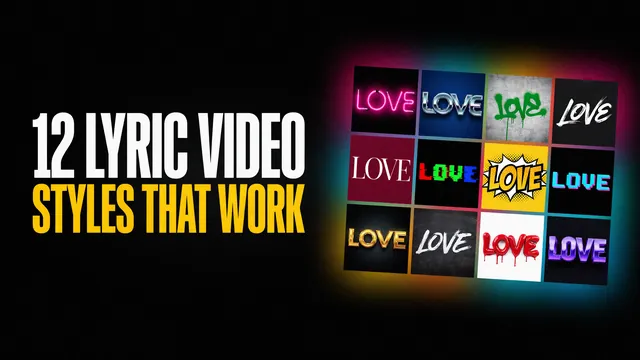
Styles spread out, too. Some lyric videos stayed simple: bold words on a still of the cover art. Others grew into full motion design, with 3D scenes and characters, and the words built into the world. Our guide to lyric video styles shows the range.
We won't put a number on this era. We looked for data on how many releases came with a lyric video and didn't find a source we trust, so we're not making one up.
| Era | How it was made | Where people watched | Typical cost |
|---|---|---|---|
| 1965 (Dylan) | Hand-written cards, filmed in one take | Cinemas, as part of a documentary | Part of a film shoot |
| 1987 (Prince) | Designed text animation | Music TV | A full video production |
| 2010 to 2014 | Kinetic type by a designer or label team | YouTube | Often under $800 for an indie label (Hopeless Records, 2013) |
| 2015 to 2020 | Motion design studios and in-house teams | YouTube, then social apps | Varies widely, from DIY to studio work |
| 2020s | Studios, plus tools that time lyrics from the audio | YouTube, Shorts, Reels, TikTok | From free (with a watermark) to studio budgets |
Costs are general, except the Hopeless Records figure from The Hollywood Reporter (2013). Checked September 2026.
2020s: vertical, short-form and automated
Two changes define the lyric video right now.
First, the screen turned tall. A 9:16 video is the tall phone shape used by YouTube Shorts, Instagram Reels and TikTok. A lyric video made only for a wide YouTube screen now needs a vertical cut too. Shorts aren't tiny clips anymore: YouTube Help says Shorts creation tools make videos "up to 3 minutes long." Many songs fit whole or nearly whole.
Second, the timing got automated. For years, the slow part of a lyric video was timing: placing every line so it lands with the voice. Now there are tools that listen to the song, write out the lyrics and time them for you.
We make one of those tools, so read this part with that in mind. Make Lyric Video takes your song file (MP3, WAV, AAC or M4A), writes the lyrics from the audio, times each word to the music and animates it as designed type. You fix any misheard words, then export.
The free version gives you an unlimited number of full-length 720p videos with a watermark on every frame. You can post them, but you can't monetize them. $29 gets 1080p, no watermark and commercial rights, emailed to you (see pricing). Neither license covers the song itself. The tool makes a wide 16:9 video; for a tall version, crop a vertical cut in a phone editor.
A tool won't replace a designer for a fully custom world around your song. It does cover the part that used to take the longest. Here's how an AI lyric video generator works, or try our AI lyric video maker directly.
Turn your song into a lyric video
Upload your song and get a full-length video with synced, designed type. Free at 720p, no account or card.
What over a decade of making lyric videos taught us
Our studio, LyricVideo.tv, has made lyric videos to order for over a decade. That's 800+ custom lyric video projects for artists and labels. We've worked with names like Snoop Dogg, Jennifer Lopez, Eminem, Miley Cyrus, Manuel Turizo and Jay Chou.
Two lyric videos you can watch, both credited to us on YouTube: Christian Anderson Band, "I Heard The Bells" (Official Lyric Video) and Paul Udarov & Jay Ray, "Heartless" (Official Lyric Video).
A few things have stayed true the whole time:
- The words are still the product. Dylan's cards worked because you could read them. Type, size and timing still decide whether a lyric video works. Our guide to lyric video typography goes deeper.
- Speed still wins. The 2013 labels liked lyric videos because they could ship on release day. Artists want the same thing now.
If you'd rather hand the whole job to a team, our studio makes custom lyric videos to order.
FAQ
What was the first lyric video?
Bob Dylan's 1965 clip for "Subterranean Homesick Blues" is the one most people point to. Dylan flips cue cards with words from the song while it plays. Sources call it an early form of the music video, not a lyric video, but it's the format's clear ancestor. Prince's 1987 "Sign o' the Times" video is often cited as one of the earliest true lyric videos.
Who made the first official lyric video on YouTube?
No reliable record names the very first one. One of the first famous label examples is CeeLo Green's "F*** You." Its kinetic type lyric video went up on YouTube on August 19, 2010, about two weeks before the official video. The Hollywood Reporter later called CeeLo "a lyric video pioneer."
Why do artists release lyric videos before music videos?
A lyric video is cheaper and faster to make than a full music video, so it can go live on release day. In 2013, Hopeless Records said it rarely spent more than $800 on one. It also helps fans learn the words. The full music video, if there is one, can follow later.
Is there an award for lyric videos?
Yes, there was. The 2014 MTV Video Music Awards, held on August 24, 2014, included a Best Lyric Video category. 5 Seconds of Summer won for "Don't Stop." Other nominees included Ariana Grande, Demi Lovato, Austin Mahone and Katy Perry.
Are lyric videos still popular?
Yes. They remain a standard part of how songs are released, and they now come in tall 9:16 cuts for Shorts, Reels and TikTok as well as wide YouTube versions. For the reasons people watch them and what the numbers show, see our post on why lyric videos are popular.
The format that once took a label's design team now starts with one song file. Make your own lyric video, or upload your song on Make Lyric Video and get a full-length video free at 720p.